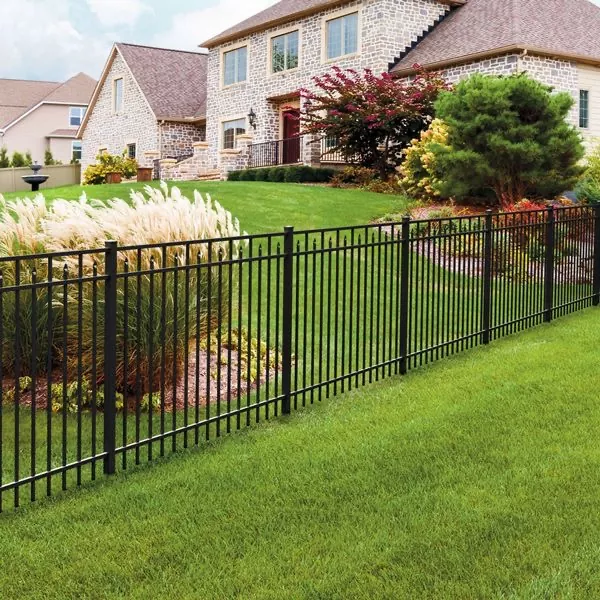
When safety demands precision and design demands personality, Decorative Aluminum Art Guardrails transform ordinary spaces into visual statements without compromising structural integrity. Our custom fabrication process treats each project as a unique composition, where load-bearing calculations coexist with laser-cut patterns that cast deliberate shadows across terraces and walkways. The interplay between perforated panels and solid sections creates rhythm along Balcony Aluminum Art Guardrails, while the alloy’s natural corrosion resistance ensures that intricate motifs remain crisp through decades of coastal exposure. For commercial facades and residential renovations alike, Modern Aluminum Art Guardrails offer clean geometrical lines that architects specify to achieve minimalist continuity across elevations. The application of advanced electrostatic coating systems results in Powder Coated Aluminum Art Guardrails with exceptional adhesion and color retention, tested at 2,500+ hours of salt spray resistance to outlast traditional wet-paint finishes in aggressive environments.
Custom Aluminum Art Guardrails represent a deliberate shift away from generic off-the-shelf safety barriers toward architectural elements that carry the designer’s intent from concept to fabrication. Each rail section emerges from a workflow that translates digital artwork into precision-cut aluminum panels, where modern waterjet and fiber laser technologies achieve tolerances within ±0.3 mm across sheet dimensions up to 3,000 mm by 1,500 mm. The material itself starts as 6063-T6 or 5052-H32 alloy billets, selected based on whether the application prioritizes structural load requirements or formability for complex curved profiles. Post-cutting processes include vibratory deburring that rounds every edge to a consistent radius, chemical conversion coating that etches the surface at a microscopic level for primer adhesion, and a multi-stage pretreatment line that removes all trace contaminants before the powder application booth. Our vertical integration allows Custom Aluminum Art Guardrails to be engineered with concealed fastening systems where stainless steel brackets anchor into aluminum posts without visible weld marks or exposed hardware from the viewing side. Infill patterns range from nature-inspired organic perforations to parametric geometric grids, with open area ratios calibrated between 45% and 78% to satisfy both wind load calculations and visibility requirements. Tempered glass inserts can be specified with digitally printed ceramic frit patterns that align precisely with the aluminum framework, creating composite panels that diffuse light while maintaining the railing’s continuous aesthetic language across floor transitions and corner returns.
Technical Specifications & Material Properties
Every Custom Aluminum Art Guardrails system is built around a core set of material and dimensional parameters that define performance across diverse installation scenarios:
- Primary Alloys: 6063-T6 for architectural extrusions (ultimate tensile strength 241 MPa, yield strength 214 MPa); 5052-H32 for sheet components (ultimate tensile strength 227 MPa, yield strength 193 MPa)
- Standard Post Dimensions: 50×50 mm, 60×60 mm, or 80×80 mm square profiles with wall thickness ranging from 2.0 mm to 4.0 mm depending on span
- Top Rail Profiles: Continuous extruded handrail sections with integrated LED channel options, available in rounded, beveled, or flat-top grip designs
- Infill Panel Thickness: 3.0 mm to 6.0 mm aluminum sheet, with thicker gauges recommended for high-traffic public spaces
- Surface Preparation: Seven-stage immersion pretreatment including alkaline degreasing, dual rinsing, titanium zirconium conversion coating, and forced hot-air drying
- Powder Coating: Polyester TGIC-free formulations applied at 60–100 microns cured at 200°C, meeting AAMA 2604 and Qualicoat Class 2 standards
- Fastener Specifications: Grade 316L stainless steel throughout, with nylon isolation washers preventing galvanic contact between dissimilar metals
- Load Compliance: Designed for uniform live load of 0.75 kN/m applied horizontally at top rail height, concentrated load of 0.89 kN at any point, per IBC 1607.8
| Parameter | Standard Range | Custom Options | Testing Standard |
|---|---|---|---|
| Overall Height | 900–1,100 mm | Up to 1,500 mm for overlooks | IBC 1015.3 |
| Post Spacing | 1,200–1,500 mm | Engineered up to 1,800 mm with reinforcement | ASTM E985 |
| Infill Open Area | 45%–78% | Custom pattern-specific calculation | Wind tunnel verified |
| Powder Cure Time | 12–18 minutes at 200°C | Extended cycles for textured finishes | ISO 8130 |
| Coating Thickness | 60–100 μm | 80–120 μm for coastal zones | ASTM D7091 |
| Pencil Hardness | H–2H minimum | Up to 4H with ceramic additives | ASTM D3363 |
| Impact Resistance | 45 kg·cm direct impact | Reinforced core panels available | ASTM D2794 |
| Warranty Duration | 15 years structural | 25 years coating performance | Written certification |
Fabrication Precision & Design Flexibility
The manufacturing sequence for Custom Aluminum Art Guardrails begins with digital pattern refinement where customer-supplied artwork or our design library selections undergo vector optimization for cutting path efficiency. Waterjet cutting using 80-mesh garnet abrasive at 55,000 psi produces edge quality suitable for exposed perimeters where the cut line becomes a deliberate design feature. Fiber laser systems operating at 4 kW deliver narrower kerf widths and faster processing on gauges up to 4 mm, with nitrogen assist gas producing oxide-free edges ready for immediate coating. Post-cutting, panels enter a CNC press brake stage where bend radii are maintained at 1.5 times material thickness minimum to prevent stress cracking in the heat-affected zone. Welding procedures follow AWS D1.2 standards for structural aluminum, with pulsed MIG techniques minimizing distortion on long linear joints through controlled heat input and skip-sequence patterns. Each completed assembly undergoes dimensional inspection on granite surface plates using digital height gauges calibrated to 0.01 mm resolution, verifying that mounting hole positions align with field anchor templates within a 1.0 mm positional tolerance zone. For projects requiring integrated lighting, LED extrusion channels are milled directly into top rail profiles before powder coating, with wiring raceways concealed inside hollow post sections that route conductors to junction boxes recessed within base plates.